In case you didn’t know it, when you are 20-21 years old and still like your parents and family, it is important to keep in touch with them. Especially if you aren’t going to be seeing them for at least four months. I know this because I had to take a test to prove this is the case. I’m happy to say I passed with flying colors. The answer to the question “Have you talked to your family about how you are going to stay in touch with them?” is B. No. I don’t think that it is relevant.
Just kidding. The answer is “Yes.”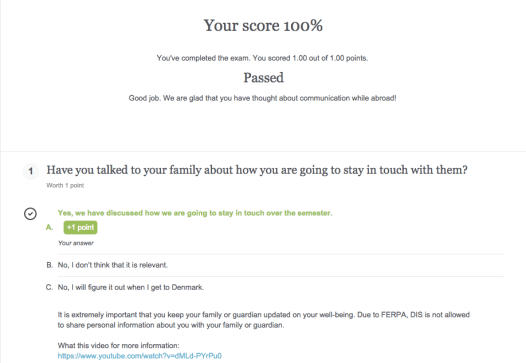
Further related to communication, DIS requires us to have a Danish cell phone number. This means we need a ten digit number beginning with the country code +45. They tell us this before we leave for Copenhagen, probably trying to be helpful and guide us through the process. I’ll tell you now, the topic of Danish cell phone numbers should not have been introduced until arrival in Denmark.
According to the DIS website, there are a few ways you can acquire your new Danish number that you will never remember. I know that mine is a combination of 3s, 9s and 0s. And maybe a 1?
“Piccell Wireless: PicCell Wireless is an American company and provides DIS students a discounted cellular package including a phone and a Danish SIM card with a local phone number for the length of time that you choose.
Global Student: Global Student provides free Danish SIM cards through a preferential agreement with Lebara Mobile.”
Both companies also offer the option of renting a Danish SIM card to be used in your unlocked smartphone. Whatever that means.
Being me, I waited until the week before I was supposed to arrive in CPH to begin research on this cell phone business. With my AT&T plan, my phone works internationally (for an additional fee that isn’t cheap) and why confuse myself with a new phone on top of the other looming challenges inherent in living in a new place (international or not). And so, I arbitrarily decided on Piccell only to fail completely at picking a plan, a phone, a SIM card, pretty much at a loss in my effort to responsibly and efficiently join the Danish cellular-sphere.
I was comforted/not really comforted at all by my further failures to find answers to a long list of cell phone questions online. Past students’ blog posts said nothing about their fight for a Danish phone number. Instead,”Save money on your phone bill, communicate via Facebook,” wrote Karla from Bates (see no. 11 here) “…it saves a ton of money.” The Facebook group for my abroad program had no information either — previous students offered long-winded answers that translated to “I did something like this but I don’t really remember. Sorry!” What’s more, I learned that wireless companies used by students studying abroad in Europe had been sued for overcharging naive kids (like me when it comes to this communications stuff). Read an article on that here.
I decided to get on the plane without a plan for my Danish number and phone. I’d rely on my internationally working smartphone for the time being knowing that the cost to call and/or text home is per minute and adds up quickly. Upon arrival at DIS at the airport, and for the next three days of “Arrival Workshop,” Piccell and Lebara (another telecom company) had tables and representatives posted. They had spreadsheets and charts that outlined details of the various plans and their costs. The friendly English-speaking women working clarified that I could use my unlocked smartphone with a Danish SIM or I could rent a phone and SIM from them. Either option works. Do what feels right. I decided on a $45 (295 DKK) plan that gives me unlimited texts to other Danish numbers and unlimited calls to the U.S.
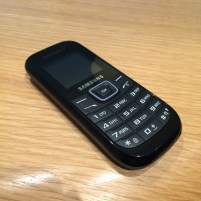 I’m re-learning how to type on a T9 keyboard and making up abbreviations for words (ex. good=gd). I have four hideously simple wallpapers to choose from. My voicemail is in Danish and I’m not sure it works.
But the phone does the job. I rely on my wifi connecting iPhone for most communication.
Moral of the story: For future students studying abroad in Europe needing a European cell phone number, do it all when you arrive. The answer to all your questions is wait. And definitely don’t order one in advance expecting it to be sent to you in your home state. A friend is still waiting for his to arrive…
One last comment before my next post, I mentioned I went to Humac (the Apple Store). This is because my dark room in Nørrebro (it is winter when days are short) is not equipped with wifi and my computer lacks the ability to directly connect to an ethernet cable. The plight for technology continues (and serves as a reminder of how connected so many of us are, so much of the time). Then, as if I would know this without being told, the European outlets in my room have individual on/off switches. Initially, I thought three of the five outlets in my room were not working. And I since there isn’t much light in my room and I learned at a young age not to fool around with electrical outlets, I didn’t fiddle with the hardware. Fortunately, after a day, someone clued me in to the on/off switch on Danish outlets. Wise plan to save energy perhaps?
On the bright side, my American phone is working. And the plan I created with my family for communication (email or wifi, try not to use international calling) was broken on the first day. I guess the correct answer to “Have you talked to your family about how you are going to stay in touch with them?” is actually “Yes, vaguely. Well, kind of. I expect it will change and we will figure it out when I get to Denmark.”
 DIS 2015: A Non-Danish Blonde in Copenhagen