When we first arrived in Copenhagen and DIS welcomed us with the first orientation meeting, they showed us a picture of a table. The equality table. I listened, acknowledged, and moved on to thinking about other things.
Earlier this week, NPR had a story about the disappearance of the American Dream. The message I took from The Numbers Add Up To This: Less And Less Opportunity For Poor Kids, is the opportunity gap is widening and social upward mobility is a steeper, more difficult climb today.
Is this supposed to be a surprising article? We talk about this in every public education class. Literally every class. And I think the increasing difficulty for generations to leap beyond their parents’ class is true to some extent in Denmark too, at least in Copenhagen. I’m just not buying the whole “we are totally equal” claim here. There is no question that the Nordic countries are more equal than others. I can write about that for three pages–just ask my Equality professor (We had a test today). But there is absolutely inequality within the system of equality.
Take the equality table I mentioned above. It’s called the Super-Elliptical by Fritz Hansen.
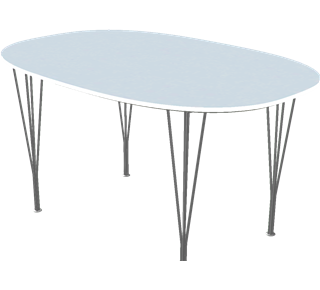
TABLE SERIES SPANLEGS Super-Elliptical by Fritz Hansen.
The Super-Elliptical is iconic to Denmark because of its rounded edges. Because there are no hard edges, everyone sits around the table “equally,” i.e. there is no head of the table. (It also comes in a circular version, but I think the elliptical/oval is the original.) Ok, so everyone is at the table in an equal position EXCEPT that 1) the table is oval so there are still longer and shorter “sides” as there would be on a truly rectangular table and 2) the table is REALLY expensive. It costs a minimum of €2000 which is just over $2000. Obviously not everyone can afford it.
Even if the table wasn’t meant to carry so much symbolism in its original design, they (Danes, the internet) sure do talk about it as a symbol of welfare and equality. Here is a description from another website selling the table: “The formula based shape has no ends and this is why the Super-Elliptical table can be seen as a democratic table where everyone has an equal position.”
A democratic table? Sitting at equal position? Seems a disadvantage for anyone stuck by a leg.
I think talking about equality is good. But it’s only as good as people act on it, you know? It’s like how we talk about the American Dream in the United States as a possibility for everyone, but if we are honest, it’s not. NPR said it exactly–family matters because it either gives you an advantage or disadvantage from the very moment you are born. It’s all about social capital and access.
As for the conversation about equality in Denmark, who really knows? Are the people who are typically disadvantaged in the equality sphere–people “who are not part of society,” because they look different or come from different backgrounds (immigrants and children of immigrants, in particular)–part of the equality conversation? Probably not. But maybe one day they will be. Yes, theoretically, upward mobility is available to everyone in Denmark because everyone has access to childcare and then to education–public or private because private schools are 80% subsidized (ok, not everyone, but a lot of people can send their kids to private school if they so choose). But I’ve heard it said multiple times that even though there is more equality in Danish education than there is in other countries, when you look at numbers, Danish achievement rates are not has high as they are in other countries. Haven’t confirmed that though.
Anyway, if I’m going to sit at a democratic table, I’d much prefer a tulip table such as the one below. No issues with table legs clashing with human legs at this one.

 DIS 2015: A Non-Danish Blonde in Copenhagen