The New Princess Diaries

The first full week of classes is coming to an end.

On Monday, I finished my last class at 14:35 (2:35 in American), did some homework for Tuesday. And was at a loss for how I should spend all this free time we apparently have. Mom challenged me with an indoor activity of identifying all of the things on this tea towel.
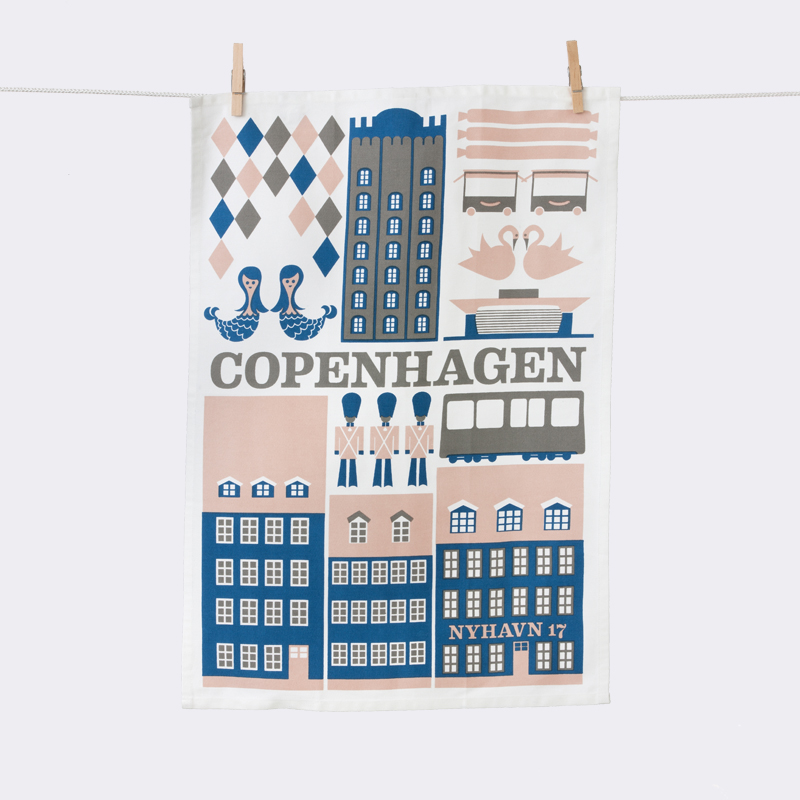
Can be purchased at http://ow.ly/I8ELs

From top left moving clockwise there is Little Mermaid and allusion to the ports. Top-middle: Christiansborg (Parliament). Christiansborg houses all branches of Denmark’s government – Parliament, the Monarch, and the Justice System. Royal Opera House or Playhouse known as Skuespilhuset. A bus that represents the public transportation system. Danes use trains, buses and the metro. One-third of the population rides bikes. Nyhavn  (pronounced Newhown), iconic because of the colorful rows of houses. Today Nyhavn 17 is a restaurant. No. 9 is the oldest house in the area dating back to 1681, and Hans Christian Andersen lived in no. 20, 67 and 18.Bottom-middle depicts Amalienborg (Royal Palace) and guards who look like the British ones outside Buckingham Palace. The changing of the guard happens daily at 11:30am.The Royal Family is the head of the highest order of Denmark, the Order of the Elephant. You will see them wearing an elephant chain and pendant for major events. Lastly, in the bottom left corner, an unnamed building/unrecognizable to this viewer.

Yesterday was my first real day with nothing scheduled. Usually on Wednesdays we have field studies around the city. I ventured to the Statens Museum for Kunst, the National Gallery of Denmark and the Royal Library, known as The Black Diamond. You might find me reading and/or writing there for the next couple of months.

We’ve decided to end this week with an adventure. Traveling by train, boat and foot, we plan to make a loop Around the Sound to visit Malmø and Helsingbørg in Sweden, return to Denmark in the north at Helsingør and then back to København. We are trusting people of the internet and our few attempts to ask questions. I’m excited.

More comments/observations:
– Bike riding is huge here. Bikers ride in designated bike lanes between the pedestrian sidewalks and the bus lanes and follow the rules of traffic lights (there are smaller lights posted in the bike lanes.) I have yet to be hit, though there have been a few close calls. I haven’t taken to two wheels (yet).
– I’ve embraced wearing all black. Black pants, black shirt, black shoes. Black-and-white scarf. People smile when I respond to their Danish with “I’m sorry. I only speak English.” I am taking Danish language lessons.
– When Danes want to get off the bus but they are sitting by the window, they just fidget with their bag handles or make a little noise to signify that the bus is approaching their stop. Some non-Danes interpret this as rude behavior. In reality, small talk does not exist here and many Danes think Americans talk too much. I am not aware of a Danish word for please and people don’t really say excuse me (undskyld).
– I’m loving my Royalty class. I intend on becoming a princess. As a woman, if I marry the Crown Prince, I can assume the title Queen when he becomes King. However, a man who marries the Crown Princess can never be called King. Unfortunately for me, both of the Danish princes are accounted for in marriage… Sources tell me the princesses are pretty great.  

Photo courtesy of Hello magazine, 03 JANUARY 2014

L to R Princesses Marie and Mary with elephants       and tiaras. Photo courtesy of Hello magazine          03 JANUARY 2014

Crown Princess Mary and Crown Prince Frederik

Crown Princess Mary and Crown Prince Frederik of Denmark
 

Jeg hedder Sophie

Pronounced “Ya hell-eh So-f-ee” meaning “My name is Sophie.” Literally more like “I am called Sophie.”

I’ve decided to take Danish. The course covers basic conversational Danish language and includes an element of Danish culture.

So far I’ve learned:
København (Koobenhown) = Copenhagen
Hej (Hi) = Hi
Hej hej (Hi hi) = Bye
Hvad hedder du? (Ve helle do?) = What is your name?
Hvor kommer du fra? (Va comm-mer do fr-ra?) = Where are you from?

Biggest take-away:
No words are spelled the way they sound.


Quick notes before I forget: Kids here wear snowsuits for jackets. It is adorable. Everyone wears black all the time. Almost all Danes speak English because they take it in school. Coin based currencies really weigh down your pockets. It’s pretty easy to walk the entire city of Copenhagen in a day if you wanted to/felt ambitious. I have been spoken to in Danish a few times now (Remember I am blonde and wear all black. Clearly I fit right in).


What’s your number? Hold on. I have to look it up…

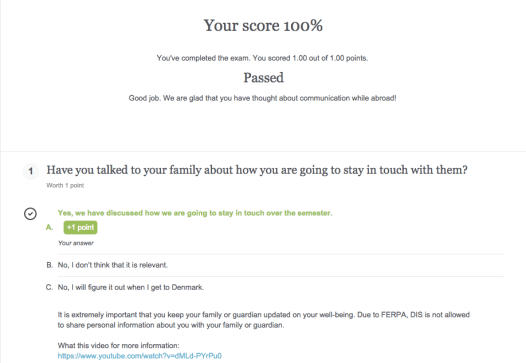
In case you didn’t know it, when you are 20-21 years old and still like your parents and family, it is important to keep in touch with them. Especially if you aren’t going to be seeing them for at least four months. I know this because I had to take a test to prove this is the case. I’m happy to say I passed with flying colors. The answer to the question “Have you talked to your family about how you are going to stay in touch with them?” is B. No. I don’t think that it is relevant.

Just kidding. The answer is “Yes.”Communication

Further related to communication, DIS requires us to have a Danish cell phone number. This means we need a ten digit number beginning with the country code +45. They tell us this before we leave for Copenhagen, probably trying to be helpful and guide us through the process. I’ll tell you now, the topic of Danish cell phone numbers should not have been introduced until arrival in Denmark.

According to the DIS website, there are a few ways you can acquire your new Danish number that you will never remember. I know that mine is a combination of 3s, 9s and 0s. And maybe a 1?

Piccell Wireless: PicCell Wireless is an American company and provides DIS students a discounted cellular package including a phone and a Danish SIM card with a local phone number for the length of time that you choose.

Global Student: Global Student provides free Danish SIM cards through a preferential agreement with Lebara Mobile.”

Both companies also offer the option of renting a Danish SIM card to be used in your unlocked smartphone. Whatever that means.

Being me, I waited until the week before I was supposed to arrive in CPH to begin research on this cell phone business. With my AT&T plan, my phone works internationally (for an additional fee that isn’t cheap) and why confuse myself with a new phone on top of the other looming challenges inherent in living in a new place (international or not). And so, I arbitrarily decided on Piccell only to fail completely at picking a plan, a phone, a SIM card, pretty much at a loss in my effort to responsibly and efficiently join the Danish cellular-sphere.

I was comforted/not really comforted at all by my further failures to find answers to a long list of cell phone questions online. Past students’ blog posts said nothing about their fight for a Danish phone number. Instead,”Save money on your phone bill, communicate via Facebook,” wrote Karla from Bates (see no. 11 here) “…it saves a ton of money.” The Facebook group for my abroad program had no information either — previous students offered long-winded answers that translated to “I did something like this but I don’t really remember. Sorry!”  What’s more, I learned that wireless companies used by students studying abroad in Europe had been sued for overcharging naive kids (like me when it comes to this communications stuff). Read an article on that here.

I decided to get on the plane without a plan for my Danish number and phone. I’d rely on my internationally working smartphone for the time being knowing that the cost to call and/or text home is per minute and adds up quickly. Upon arrival at DIS at the airport, and for the next three days of “Arrival Workshop,” Piccell and Lebara (another telecom company) had tables and representatives posted. They had spreadsheets and charts that outlined details of the various plans and their costs. The friendly English-speaking women working clarified that I could use my unlocked smartphone with a Danish SIM or I could rent a phone and SIM from them. Either option works. Do what feels right. I decided on a $45 (295 DKK)  plan that gives me unlimited texts to other Danish numbers and unlimited calls to the U.S.

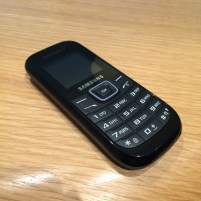
Danish PhoneI’m re-learning how to type on a T9 keyboard and making up abbreviations for words (ex. good=gd). I have four hideously simple wallpapers to choose from. My voicemail is in Danish and I’m not  sure it works.


But the phone does the job. I rely on my wifi connecting iPhone for most communication.

Moral of the story: For future students studying abroad in Europe needing a European cell phone number, do it all when you arrive. The answer to all your questions is wait. And definitely don’t order one in advance expecting it to be sent to you in your home state. A friend is still waiting for his to arrive…

One last comment before my next post, I mentioned I went to Humac (the Apple Store). This is because my dark room in Nørrebro (it is winter when days are short) is not equipped with wifi and my computer lacks the ability to directly connect to an ethernet cable. The plight for technology continues (and serves as a reminder of how connected so many of us are, so much of the time). Then, as if I  would know this without being told, the European outlets in my room have individual on/off switches. Initially, I thought three of the five outlets in my room were not working. And I since there isn’t much light in my room and I learned at a young age not to fool around with electrical outlets, I didn’t fiddle with the hardware. Fortunately, after a day, someone clued me in to the on/off switch on Danish outlets. Wise plan to save energy perhaps?

On the bright side, my American phone is working. And the plan I created with my family for communication (email or wifi, try not to use international calling)  was broken on the first day. I guess the correct answer to “Have you talked to your family about how you are going to stay in touch with them?” is actually “Yes, vaguely. Well, kind of. I expect it will change and we will figure it out when I get to Denmark.”


The First 72 hours

After a long and lonely day and night of traveling to Copenhagen, skies grey and sprinkling but not quite raining, I arrived at Bispebjerg Kollegium where I will be living for the next four months. I have a single room with a mini-kitchenette and an in-room bathroom with a shower basically on top of the toilet. The bathroom pretty much floods whenever I take a shower. We met our SRAs (like RAs but way more casual and WAY less informative/comforting when it comes to settling in), went to our individual rooms, and spent the day alone and homesick. Sunday sucked, to say the least. I must have called home at least three times just to hear my parents’ voices which naturally only made me feel more alone.

I slept through the night, sort of, if you call waking up three times sleeping through. Woke up at 8am in order to meet the rest of the Kollegium and two of our SRAs promptly at 9am so they could take us to our first day of Orientation in Central Copenhagen. Because there were 50 of us traveling at once, Bo and Buster took us on the S train that runs right outside my window. “But don’t remember anything we tell you because you will never again get to school this way.” When I asked the name of the stop where we’d be getting off, I was told “it doesn’t matter. I’ll tell you.” Normally, we would take the 6A bus directly to school. It’s about 25 minutes. The train excursion took 45. And I have no idea what trains we took.

Nevertheless, we made it. We had our Opening Ceremony in Cirkusbygningen, Copenhagen’s old circus building, where we were greeted with an interpretive/acrobatic dance by Christel Stjernebjerg performed to electronic music by Mike Sheridan. Here’s a panoramic view of only half of Spring 2015 DIS students, there are 1200 total:

Cirkusbygningen

Throughout the afternoon, we were shown DIS buildings, picked up our textbooks, wandered if we wanted. I found Humac (with help from my Dad), the closest thing to an Apple Store in Copenhagen so that I could have internet in my room. (Thanks Macbook  Air for not having a built in ethernet port…) All is good now, obviously, or I couldn’t be writing this!

Day three started with another meeting about housing and living in Denmark — adapting, assimilating, cultural immersion, etc. Then the rest of the day was free. Some of us adventured away from DIS to Nyhavn to see the colorful houses on the harbor port and then to see the famous statue of the Little Mermaid, Den lille Havfrue. Stopped in for a warm drink and some recharging before finding the 6A bus that would take us back to Bisbepjerg. The weather alternated between snow and rain all day, but stayed warm enough for everything to just become wet and cold. Including me and all the clothes I was wearing.

My current internal questions:
1. What is the protocol with eating on the go? Can I eat an apple on the bus on my way to school in the mornings?
2. Why did the pre-discussions about getting a Danish cell phone number have to be so complicated? Getting my number and my middle-school-esque Samsung phone was possibly the easiest thing I did yesterday. More on the challenges of tech later.
3. Where do I live exactly? What can I do around here?
4. Since it is dark here all the time, why doesn’t my room have more than one light?
5. Why is it so hard to find a useful map of the city, the buses, the metro? Thank goodness for Google maps!

Getting Ready for a Semester Abroad

Things to Know:

Denmark’s Prime Minister is Helle Thorning-Schmidt, the first woman to hold the position.

Queen Margrethe II has been Head of State since 14 January 1972.

Borgen means “the castle” and is short for Christiansborg Palace, the building that houses the three branches of Danish government (Parliament, Prime Minister and Supreme Court). It is also the name of a Danish tv drama, subtitled in English.

Tak = thank you; bæ = poop

Currency used is the Danish Kroner. 1 US Dollar  = 6.43 Danish Krone

Of the three main islands that comprise Denmark, Copenhagen is on the main island of Zealand.

This week’s NY Post ran an article dismissing the notion that Scandavian countries are utopias.  I am holding on to the idea that Denmark, “routinely leads the world in happiness surveys.”